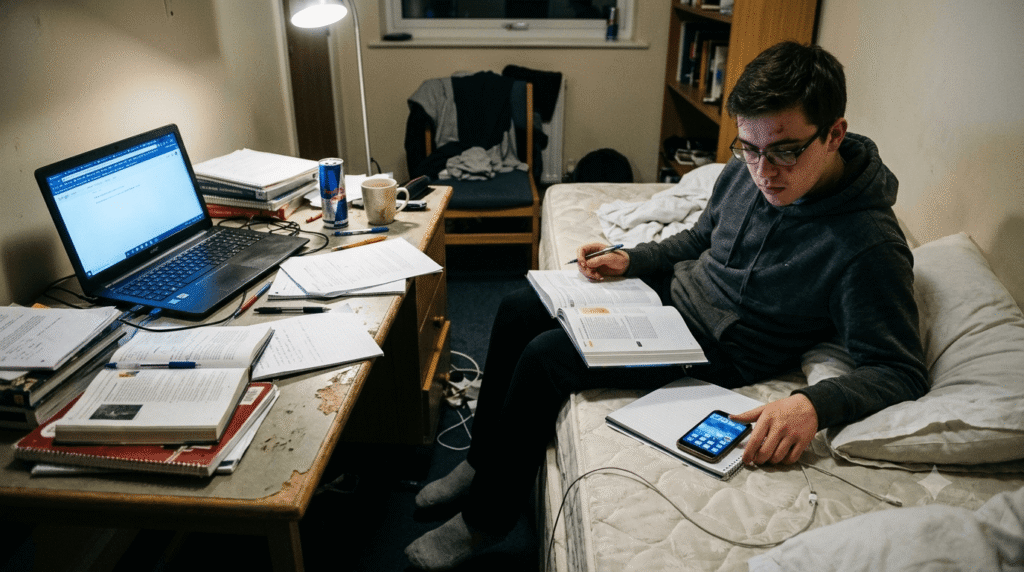
Are you unknowingly making critical study setup mistakes that drain your focus and cause exam fatigue? We have all been there. Indeed, you sit down with your notes, determined to crush a heavy syllabus, but within 20 minutes, your back hurts. Consequently, your mind wanders and you reach for your phone. Often, the problem is not your willpower—it is your environment.
To maximize your productivity, your physical workspace needs to work for you, not against you. In fact, tiny changes to how your desk is organized can make the difference between a 4-hour deep study session and an evening lost to constant distractions.
Since your exam schedule is already packed, you need quick, simple fixes. Therefore, avoid these 4 common mistakes to keep your focus sharp and your productivity high!
1. Studying on Your Bed (One of the Biggest Study Setup Mistakes) 🛏️
- The Mistake: Propping up pillows and trying to review heavy books or notes while lounging on your bed.
- Why it hurts: Your brain deeply associates your bed with sleep and relaxation. Consequently, when you try to study there, your mind gets confused. As a result, this confusion leads to instant drowsiness and lower retention rates. Furthermore, slouching on a soft mattress completely ruins your posture.
- The Quick Fix: Establish a strict boundary to prevent these study setup mistakes. The bed is only for sleeping; similarly, a dedicated chair and table are strictly for working. Even a small, simple table in a quiet corner sets the right psychological trigger for deep work.
2. Phone Distractions: Fatal Study Setup Mistakes 📱
- The Mistake: Leaving your smartphone right next to your notebook, even if it is turned face down or set to silent.
- Why it hurts: Research shows that just seeing your phone on your desk creates a subconscious brain drain, lowering your mental capacity. Moreover, every time a screen lights up or you glance at it, your focus shatters. Subsequently, it takes up to 20 minutes to get your full concentration back.
- The Quick Fix: Put your phone completely out of sight or in another room during study blocks. Alternatively, if you use it for a timer, place it across the room so you have to physically get up to check it.
💡 Boost Your Focus Desk Setup:
To keep your workspace completely distraction-free, stop using your phone as a clock. Instead, use a dedicated countdown tool like a mechanical Visual Productivity Timer to track your study intervals visually. In addition, to keep your notes organized at eye level and reduce neck fatigue while writing, consider adding a sturdy Adjustable Metal Book Stand to your desk setup.
3. Poor Lighting Gaps and Hidden Study Setup Mistakes 💡
- The Mistake: Studying under a single dim bulb or relying purely on your laptop screen’s harsh glare late at night.
- Why it hurts: Low or improperly angled lighting forces your eyes to work double time. Thus, you experience headaches, dry eyes, and mental exhaustion long before you actually finish your target chapters.
- The Quick Fix: Position your main light source so it lights up your paperwork without creating sharp shadows. For instance, a simple directional desk lamp makes an immediate visual difference.
💡 Desk Lighting Upgrades:
Protect your vision during late-night revisions with a high-quality lamp. For example, a Wipro Rechargeable LED Desk Lamp lets you adjust brightness and toggle between cool white and warm white light depending on the time of day. Meanwhile, a flexible Philips Eye Comfort Desk Lamp ensures completely flicker-free illumination across your textbooks.
4. Bad Ergonomics: Heavy Study Setup Mistakes That Ruin Your Back 🪑
- The Mistake: Sitting on a basic wooden chair with zero lower back support, hunched over your table for hours at a time.
- Why it hurts: Bad seating cuts off healthy circulation and creates muscle tension. Instead of focusing on solving tough problems, your brain becomes fixated on your body aches. Consequently, your overall learning speed plummets.
- The Quick Fix: If you don’t have an ergonomic chair, roll up a thick towel or use a firm pillow. Then, place it behind your lower back for instant lumbar support. Additionally, keep your feet flat on the ground to distribute your weight evenly.
🚨 Quick Routine Adjustments for Deep Work
The 50-10 Rule: Do not try to sit continuously for 4 hours. Instead, study with absolute focus for 50 minutes, then take a mandatory 10-minute break to stretch, drink a glass of water, and step away from your desk completely.
Clear the Deck: At the end of every night, spend exactly two minutes clearing your desk. Put away extra pens, shut random books, and leave only the next morning’s topic out. As a result, waking up to a clean, organized desk layout makes starting your next session effortless.
Your environment dictates your long-term consistency. Therefore, fix these common study setup mistakes, optimize your physical workspace, and maximize your study potential this exam season!
How does your current workspace look? Let us know in the comments below what your number one distraction is while studying!